A few years ago, a buyer looking at Young Farm on Morrisville Parkway learned something that isn't obvious from the listing photos or the builder's site plan: the community splits down the middle between two counties. The east side sits in Wake. The west side sits in Chatham. Same subdivision, same mailing address, same HOA, different property tax jurisdiction and, depending on the lot, a different school assignment. Taylor Morrison's own community page for Young Farm confirms the split, and it's not unique to that one development. Along Cary's western edge, several newer communities carry a Cary address while sitting partly or entirely in Chatham County.
That detail matters for a reason beyond trivia. It's a small, verifiable example of a larger pattern that shapes how far a Cary budget actually goes: two homes can share a town name, a price bracket, and even a builder, and still be fundamentally different products once you look past the sticker.
The Median Is Doing More Work Than It Should
Cary's median sales price reached $627,500 in August 2026, up 7.5 percent from the same month a year earlier. That's the kind of number that makes a headline. But the median price per square foot for the same month told a different story: $253, down 1.2 percent year over year. The two figures aren't contradicting each other by accident. A median tracks whichever homes happened to close that month, and August 2026 apparently saw more of Cary's larger, pricier homes change hands than usual. Individual square footage wasn't necessarily worth more. The mix of what sold simply shifted upward.
Closed sales rose too, 162 for the month, up 6.6 percent year over year, while active inventory fell 13.2 percent to 363 homes and new listings stayed close to flat. Fewer homes on the market, similar new supply coming in, and a media price climbing while cost per square foot slips. That combination tells a buyer something specific: don't read the headline median as a stand-in for what any particular Cary property is worth. Read it as evidence that the market is thinner and more selective than it looks.
West Cary Is Where the Growth Actually Lives
Zoom into the western third of town, the newer corridor built out mostly after 2000 and accelerating after 2015, and the picture sharpens further. Neighborhoods like Amberly, Cary Park, Carpenter Village, and the newer pockets around Green Level and Highcroft posted price growth of roughly 5.7 percent over the past year even as the town overall stayed flat. Homes there sold in about 18 days, with close to a third closing above list price, on nearly 360 sales, a meaningfully higher transaction count than the year before.
This is where Cary's building activity is concentrated, and it's not hard to see why. Amberly alone spans more than 1,100 acres and roughly 5,000 homesites, planned back in 1995 as a live-work-shop community and still adding inventory today, with recent listings ranging from the mid $600,000s to the mid $700,000s depending on the month and which section of the neighborhood you're comparing. Carpenter Village, a smaller and older-feeling community named for area settler William Carpenter, offers a walkable, porch-heavy Southern streetscape with prices that vary widely by unit type, from townhomes in the $500,000s up toward $700,000 for larger single-family homes.
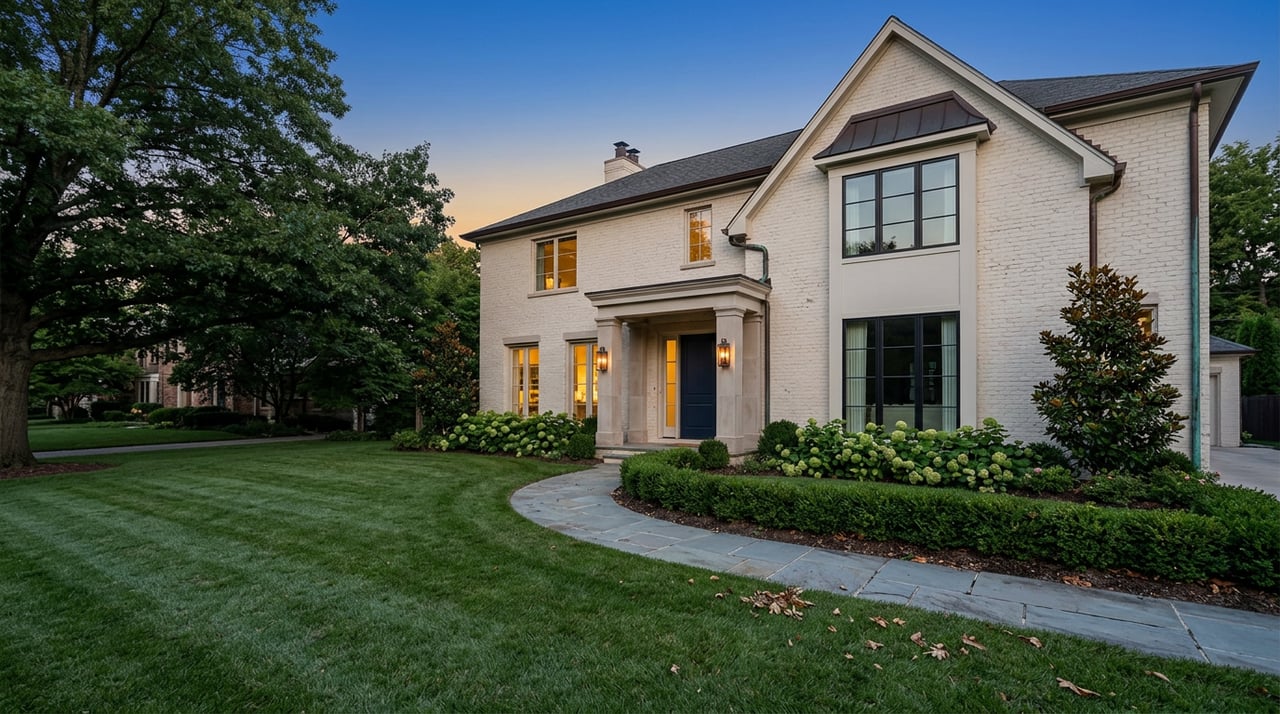
What buyers are paying for in this corridor is largely finish level and layout. Open kitchens, primary suites sized for how people actually live now, energy-efficient systems, three-car garages. It's a straightforward trade: you're buying 2019 or 2024 construction standards on a planned-community lot, usually with an HOA and amenity package attached.
Preston and MacGregor Downs Are Selling Something Different
Head to the established side of town and the math changes. Preston, one of Cary's flagship communities, spans nearly 1,950 acres and roughly 1,625 homes across subdivisions like Preston Village, Preston Pines, Preston Grande, and Preston Forest, built around Prestonwood Country Club after SAS Institute acquired and developed the land starting in 1991. Housing there ranges from townhomes near $300,000 to custom estates exceeding $3 million, with an average value around $1 million. MacGregor Downs, anchored by its own country club and known for lake views and larger lots, sits in a similar upper bracket, generally priced from the $450,000s into the $800,000s for existing homes.
At a comparable price point to a new West Cary listing, a Preston or MacGregor Downs home is more likely to be a 1988 or early-1990s build. That means mature trees, a bigger lot, and a floor plan built for how people lived nearly four decades ago: a formal living room that rarely gets used, a kitchen closed off from the rest of the house, a primary bath with a garden tub that eats up the footprint. That's not a flaw so much as a different kind of value. Buyers who understand which walls are load-bearing and which aren't can often open up a kitchen or rework a primary bath for a fraction of what equivalent new-construction square footage costs, while keeping the land and the setting that made the neighborhood desirable in the first place.
So the real comparison isn't "expensive Cary" versus "affordable Cary." It's newer finishes on less land versus older bones on more land, at prices that can land in the same range depending on the specific street.
Part of West Cary's Price Story Is Still Ahead of Itself
There's a second layer worth knowing before treating West Cary's momentum as a settled fact. Some of the growth narrative for that corridor, and for neighboring Morrisville, is tied to Apple's planned East Coast Hub at Research Triangle Park, a $552 million campus announced in 2021 with roughly 3,000 jobs attached, located on Little Drive on the Wake County side of RTP. Construction on that project paused in 2024, and Apple received a four-year extension on its state incentive agreement. Late in 2025, the company filed a new commercial use application for a 324,000 square foot office building, an indication the project is moving forward, just on a revised timeline.
That matters for anyone weighing West Cary's appreciation against its price tag today. Some of what buyers are paying for is proximity to jobs that are still a few years from fully landing, not jobs that have already arrived. It doesn't undo the case for West Cary. Apple has still added more than 600 employees to its North Carolina team over the past three years, and the broader RTP employer base, SAS Institute, Cisco, Lenovo, remains firmly in place. But it's worth knowing that part of the price you're paying is a bet on a timeline, not a reflection of jobs already on the ground.
What This Means If You're Actually Comparing Two Listings
If you're weighing a West Cary new-construction listing against something in Preston or MacGregor Downs at a similar number, the question isn't which one is the better deal. It's which trade you'd rather make: paying for finish level and amenities now, or paying for land, established landscaping, and a renovation project you can shape yourself. Both are legitimate ways to spend the same dollars in Cary. They just produce very different homes five years from now.
And if the listing in question happens to sit near Cary's western edge, it's worth a quick check on which county actually holds the parcel before you get too far into the process. Tax rates and school assignments run on county lines, not on the marketing name of the community.
A Few Questions Worth Asking
Does it matter whether my home is in Wake County or Chatham County if the address says Cary? Yes. Property tax rates and school district assignment follow the county line, not the town's marketing boundary. Communities like Young Farm straddle both, so it's worth confirming which side of the line a specific lot falls on before writing an offer.
Why did Cary's median price rise in August 2026 while some neighborhoods barely moved? The median tracks whichever homes happened to close in a given month. A month with more large, expensive single-family sales can push the median up even while the price per square foot, a steadier measure of underlying value, holds flat or slips.
Should I buy new construction in West Cary or an older home in Preston or MacGregor Downs? That depends on what you'd rather manage. New construction gets you a finished, modern layout with less flexibility to change it. An older home on a larger lot gets you land, mature trees, and the ability to reshape the floor plan, at the cost of taking on that work yourself.
Cary's price data rewards a closer read than the headline number gives you, and the neighborhood you land in will shape your next decade as much as the price on the sign does. If you're comparing specific streets, or you want a second set of eyes on what a particular Cary property is actually worth before you make an offer, The Sheri Hagerty Group can walk through the comparison with you. Get a Free Home Valuation and start with the numbers that apply to your specific address, not just the town average.